
MIP UrbanTeq provides smart traffic light systems, CCTV, security systems and ITS solutions in Malaysia
Smart Adaptive Traffic Light System
Providing Everything You Need
Introduction
The Smart Traffic Light Project represents a major leap forward in modernizing urban transportation systems. By utilizing real-time data, advanced sensors, and intelligent algorithms, this system can optimize traffic flow, reduce congestion, enhance safety, and improve environmental sustainability. The success of this project not only benefits individual commuters but also contributes to the overall efficiency and sustainability of urban transportation networks, making cities smarter and more responsive to the needs of their residents.
-
Sensors and Cameras:
-
Inductive Loop Sensors: Installed in the road surface, these sensors detect the presence of vehicles at intersections. The data gathered from these sensors allows the system to adjust traffic light cycles based on traffic density.
-
Infrared and Radar Sensors: These sensors monitor traffic conditions from a distance, providing real-time information about vehicle flow, speed, and congestion.
-
CCTV Cameras: Cameras installed at intersections provide live visual feeds to control centers, enabling operators to monitor traffic conditions and detect accidents or unusual behavior in real time.
-
-
Traffic Signal Controllers:
-
The heart of the smart traffic light system is the traffic signal controller, which processes data from sensors and cameras. The controller adjusts signal timing based on real-time traffic conditions, ensuring smoother traffic flow and minimizing delays.
-
-
Adaptive Signal Control System (ASCS):
-
ASCS is the key algorithm that enables the dynamic adjustment of traffic signal timings. It takes inputs from various sensors and uses machine learning algorithms to predict traffic demand and optimize signal timings accordingly. This system continuously learns from traffic patterns and adapts to changes in real time.
-
-
Centralized Control and Monitoring:
-
A centralized traffic management system allows operators to monitor and manage multiple intersections from a control center. This system provides real-time data and analytics, enabling operators to make quick decisions and adjustments to traffic signal timings as needed.
-
-
Implementation Phases of the Smart Traffic Light Project:
-
Planning and Feasibility Study:
-
The first step is to conduct a thorough feasibility study to identify the intersections that would benefit most from a smart traffic light system. The planning phase also includes evaluating the required infrastructure, selecting suitable sensors and cameras, and designing the system architecture.
-
-
System Design and Infrastructure Setup:
-
Once the planning phase is complete, the next step involves designing the system’s hardware and software components. This includes installing sensors, cameras, and traffic signal controllers, as well as setting up the communication infrastructure for real-time data exchange.
-
-
Algorithm Development and Integration:
-
The development of the adaptive signal control system (ASCS) is a crucial step in the project. Machine learning algorithms are designed to optimize signal timings based on real-time traffic data. The system is then integrated with the hardware components, such as sensors and traffic lights.
-
-
Testing and Calibration:
-
Before full deployment, the system undergoes extensive testing and calibration to ensure that it functions as expected. This includes fine-tuning sensor sensitivity, adjusting signal timing algorithms, and validating communication between vehicles and infrastructure.
-
-
Deployment and Monitoring:
-
After successful testing, the smart traffic light system is deployed across the selected intersections. The system is continuously monitored by traffic management centers to ensure optimal performance. Data collected from the system is analyzed for further improvements.
-
-
Maintenance and Optimization:
-
Regular maintenance is essential to ensure that all components of the system remain functional. The system is periodically updated with new algorithms and features to enhance its efficiency and adapt to changing traffic patterns.
-
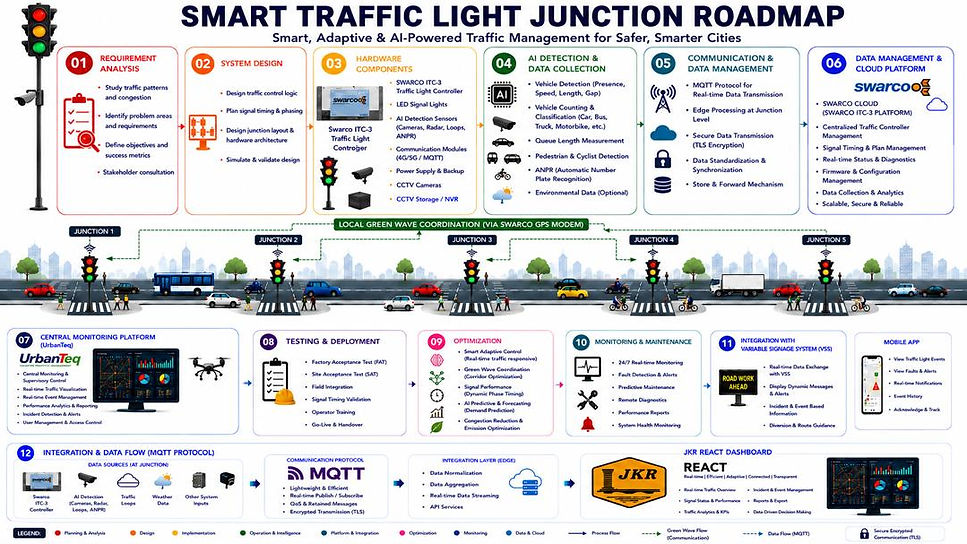
Key Components of the Smart Traffic light System:
Overview of Swarco ITC-3 Smart Adaptive Traffic Light Controller System


Smart AI Traffic Light Junction

Traffic Light Controller Cabinet

LED Traffic Light Signal Aspect
